The National Bison Production & Marketing Grant 

APPLICATIONS ARE NOW OPEN - Due, June 29th, 2026

Bison have shaped the grasslands of North America since their ancestors arrived on this continent. For tens of thousands of years, their grazing built soil, fed watersheds, and held together an ecological fabric that agriculture still depends on today. The National Bison Production & Marketing Grant (NBPMG) exists to put that relationship back to work, on working lands, with the producers raising bison today. 

The NBPMG is funded by the USDA Agricultural Marketing Service (AMS) through its Bison Production and Marketing Grant Program (BPMGP), a national effort to strengthen the economic viability, ecological performance, and market access of bison producers across the United States. The NBPMG is administered by three Prime Grant Recipients (PGRs), each leading its own grant across a distinct pillar of the bison industry. 

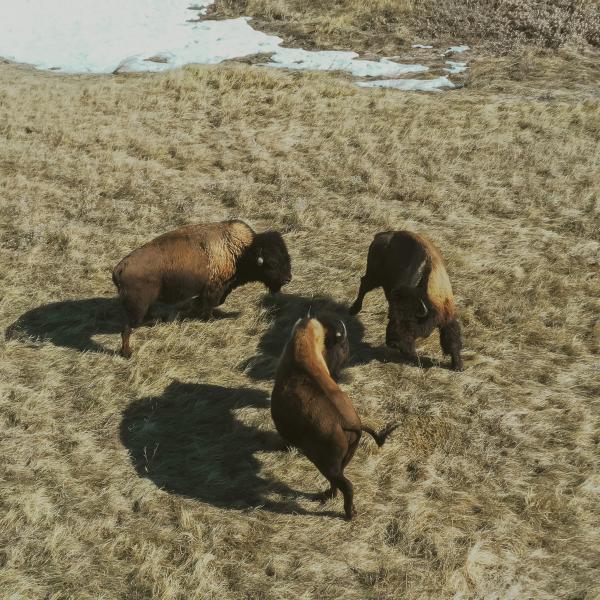
drew dau thgexfmf24c unsplash

MAD AGRICULTURE’S ROLE

Mad Agriculture leads the on-ranch production portion of the NBPMG, administering a total of $1,120,000 directly to bison producers across the nation, with awards of up to $80,000 each. Our grant is designed to address the real barriers facing bison producers today: varied production capacity, gaps in business and technical support, and the persistent challenge of building a viable, lasting operation. 

Every Mad Agriculture award pairs funding with technical assistance. All awardees receive up to three one-hour technical assistance sessions with the Mad Agriculture team at no additional cost to support implementation, troubleshooting, and connection to additional resources. Producers who need deeper support can scope additional assistance into their project, and we’ll help connect them to qualified contractors and service providers. If your project primarily focuses on bison processing, value-added products, industry-wide education, or data tools, check out either Flower Hill Institute or the National Bison Association for more information on their grants. 

Who should apply

This grant is for the people raising bison. Whether you are just starting, a few years in, or running a well-established herd, if you are working to improve, expand, or transition your operation, this is built for you. There is no minimum herd size and no acreage requirement. What matters is a clear project and the readiness to carry it out.

Producers come to us with all kinds of work in mind:

  • Grazing, land, and herd management

  • Business planning, enterprise analysis, and financial footing

  • Handling equipment and production infrastructure

  • Regenerative and adaptive grazing systems

  • Tribal and community-based bison production

If your project doesn’t fit neatly into a box but addresses a real gap in your operation, apply anyway and tell us about it in your own words.

Read the official RFA here.

WHAT we fund

Our grant supports two kinds of work, and a project can live in one or both.

The land and the herd. Adaptive grazing plans, on-the-ground assessments of forage and herd health, pasture seeding and invasive species control, and the physical pieces that enable good management: portable handling equipment such as chutes, corral panels, and scales; herd-tracking technology such as GPS ear tags; and water and fencing improvements.

The business of it. Enterprise analysis, business and market planning, tools for tracking cost and profitability, new revenue and diversification, and a stronger footing in the markets you sell into.

A note on building things: most of the equipment and infrastructure producers need is fundable. A handful of activities, like new permanent fencing, water lines that disturb the ground, or new wells, require federal environmental review before work starts, and new buildings or enclosed structures aren’t eligible at all. If your project involves physical work that could trigger a NEPA review, the FAQ and the RFA walk through exactly what that means.

APPLICATIONS ARE NOW OPEN

The application process will occur in two stages:

READ THE Request for application

stage 1:

Open Call for Letters of Interest (LOI):

Applications close: June 29th, 2026


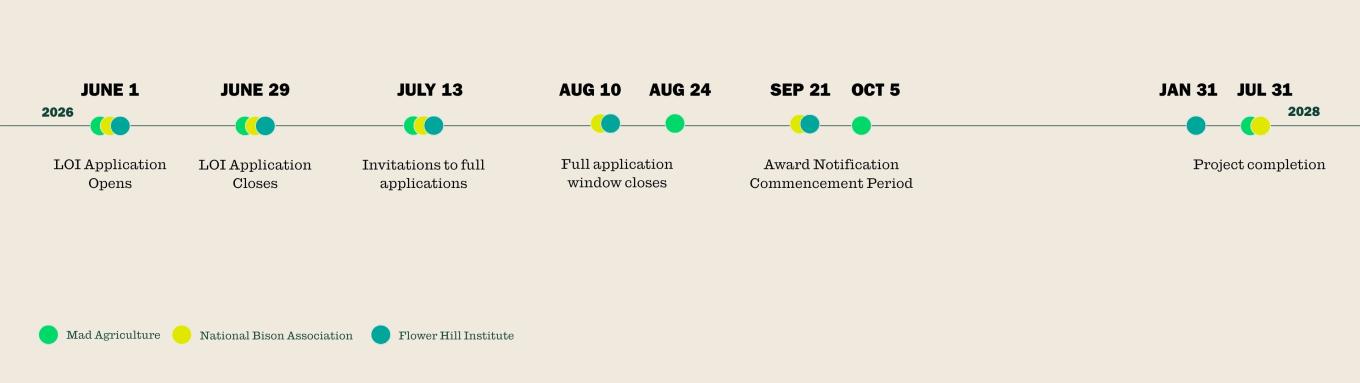
First, a Letter of Intent. Open to everyone eligible. Tell us briefly about your operation, your project idea, and the difference you expect it to make. The LOI is how we check fit and eligibility. It isn’t scored or ranked, and sending one doesn’t guarantee an invitation, but it’s the only way to receive an invitation for a full application. LOIs are due June 29, 2026, 11:59 PM CST.


stage 2:

Invitation to Apply (Full Application):

Selected applicants will be notified by June 15th, 2026.

Then, a full application, by invitation. If your LOI clears the screen, we’ll invite you to submit the full thing: a project narrative, a line-item budget, and a budget narrative. Invitations go out July 13, 2026. Full applications are due August 24, 2026, 11:59 PM CST. Award notifications begin October 5, 2026.

Read the official RFA here.

all partner 1780070400

FAQ’s

The application uses a two-step process:

Step 1 — Letter of Intent (LOI): All applicants submit an LOI by June 29, 2026, 11:59 PM CST. The LOI is an eligibility and alignment screen; it is not scored or ranked. Submitting an LOI does not guarantee an invitation to apply.

Step 2 — Full Application (by invitation only): Applicants whose LOIs pass the eligibility screen will be invited to submit a full application, due August 24, 2026, 11:59 PM CST. Invitations go out July 13, 2026, and award notifications begin October 5, 2026. For more information on the full application process, please read the Mad Agriculture Request for Applications.
For Mad Agriculture’s grant, yes. Our awards are built for active bison producers working to improve, expand, or transition their operation. If your project centers on processing, market development, product innovation, or industry education rather than on-ranch production, Flower Hill Institute or the National Bison Association is likely the better fit, and both welcome applicants who aren’t producers themselves, such as research organizations, marketing firms, technology developers, or educational institutions.

Eligible applicants include agricultural businesses or cooperatives, economic development corporations, local governments, nonprofit corporations, producer networks or associations, Federally Chartered Tribal Organizations, and Tribal Governments. For-profit entities are eligible if they are primarily engaged in bison production, processing, or marketing. Individuals applying in a personal capacity are not eligible. All applicants must be based in the 50 states or U.S. territories and must have a valid UEI number at the time of LOI submission.

The BPMGP is a national initiative authorized under Division B, Title VII, Section 764 of the Consolidated Appropriations Act of 2024 (Public Law 118-42), created to strengthen the economic viability, ecological performance, and market access of bison producers across the United States. It pairs competitive grant funding with hands-on technical assistance, carried out through the NBPMG by three organizations, Mad Agriculture, Flower Hill Institute, and the National Bison Association, each leading its own part of the work across production, processing, marketing, and education.

Three names, three layers. The BPMGP (Bison Production and Marketing Grant Program) is the federal program at USDA AMS that provides the funding. The NBPMG (National Bison Production & Marketing Grant) is the national effort that three organizations, Mad Agriculture, Flower Hill Institute, and the National Bison Association, built and administer together using that funding, each leading a different pillar of the work. Mad Agriculture’s grant is our piece of the NBPMG: $1,120,000 in awards of up to $80,000 each, focused on on-ranch production and business support. If you’re a bison producer applying for funding to improve your operation, our grant is the part of all this you’ll actually apply to, and this page is where you do it.

No. There is no minimum operation size or acreage requirement. Mad Agriculture explicitly welcomes beginning, intermediate, and advanced producers. What matters most is that you have a clear, specific project scope tied to program goals and that you are ready to implement activities within the project period.

Yes, in many cases. Mad Agriculture subawards can fund handling equipment (chutes, corral panels, scales), portable water systems, herd management technology, pasture seeding, and some fencing and infrastructure investments. However, certain physical activities, such as the installation of new permanent fencing, water pipelines requiring ground disturbance, or new wells, require federal environmental review under NEPA before work can begin. New buildings or permanently enclosed structures are not eligible under any partner. Applicants proposing physical activities should carefully review Sections 3C and 4F of the RFA before applying.

Three organizations administer subawards under this program, each with a distinct focus:

  • Flower Hill Institute leads processing, product innovation, and business capacity, with an Indigenous-centered approach. A Native-owned nonprofit based in Jemez Pueblo, New Mexico, FHI is administering $880,000 in awards of up to $150,000 each to support market access for processed bison products, byproduct and whole-animal utilization, and industry education through workshops, field days, and webinars. Explore the FHI grant.

  • The National Bison Association leads industry-wide education, data, and consumer outreach. The primary national membership organization for the bison industry, based in Westminster, Colorado, the NBA is administering $880,000 in awards of up to $150,000 each, funding work like the next edition of the Bison Producer’s Handbook, a first-of-its-kind industry valuation and supply chain analysis, a national consumer campaign, and new data tools like a genetic registry. Explore the NBA grant.

  • Mad Agriculture (MA) — A Boulder, CO-based nonprofit. Mad Ag administers up to 20 awards (up to $100,000 each) focused on regenerative bison management, production infrastructure, and business support for working bison producers, paired with direct technical assistance.

Each organization runs its own application on its own timeline, so check their sites for current dates.


For questions, you can reach out to the partner organization you plan to apply to:

Flower Hill Institute: Harleigh Moore Wilson, Director of Agriculture — info@flowerhill.institute

National Bison Association: Lydia Whitman, Program Manager — info@nationalbison.org

Mad Agriculture: Rayle Heinzig, Land & Business Project Manager — rayle@madagriculture.org

Mad Agriculture is administering a total of $1,120,000, with a maximum of $80,000 per award. Projects can run up to 22 months and must end by July 31, 2028. You’re welcome to propose a budget below the maximum, and a smaller, well-scoped request can be just as competitive as a larger one.

A few things are off the table, no matter the project: buying land or real estate; paying down debt; general operating costs not tied to the project; lobbying or political activity; and general-purpose vehicles like trucks, pickups, ATVs, and UTVs, regardless of how they’d be used. New buildings and permanently enclosed structures aren’t eligible either. For the full list, see Section 4E of the Mad Agriculture RFA.

No. There is no minimum operation size or acreage requirement. Mad Agriculture explicitly welcomes beginning, intermediate, and advanced producers. What matters most is that you have a clear, specific project scope tied to program goals and that you are ready to implement activities within the project period.

You need a valid UEI (Unique Entity Identifier) when you submit your LOI, which you can get fairly quickly at sam.gov. Full SAM.gov registration takes longer, often four weeks or more, and must be active before we can invite you to submit a full application. If you’re thinking about applying, start that process now rather than later; an otherwise strong applicant can miss out simply because registration wasn’t active in time. See Section 6D of the RFA for the details.

Every Mad Agriculture awardee gets up to three one-hour sessions with our team at no cost to help with implementation, work through problems, and connect to other resources. If your project needs more support than that, describe what you need in your application and include it in your budget; we can also help connect you with qualified contractors and service providers.

If you’re awarded, you’ll sign a subaward agreement with Mad Agriculture and keep your SAM.gov registration active through the life of the project. From there, the main commitments are: a couple of progress reports over the project period, a final report at the end, and an openness to sharing what you learn, sometimes through a peer conversation, workshop, or webinar, so other producers can benefit from your work. The specifics are in your subaward agreement, and we’ll walk you through it all.

OUR PARTNERS

Sorry! Donations can not be purchased at the same time as goods