
Wilding White Paper
Two centuries of row crop expansion have removed hundreds of millions of acres of native habitat from the American landscape. The consequences are measurable: bird populations down 29% since 1970 (Rosenberg et al., 2019), more than a third of native bee species at elevated extinction risk (Cornelisse et al., 2025), agricultural watersheds driving hypoxic zones in the Gulf of Mexico (US EPA, 2017), and billions of tons of carbon lost from soils (Sanderman et al., 2017). What habitat remains is severely fragmented; isolated patches that can’t support wildlife movement, sustain viable populations, or deliver the ecosystem services that farms and food systems depend on.
The research is also clear that this can change. When native perennial cover is sited strategically (on the steep slopes, wet corners, and underperforming acres that already cost farmers money) the results are striking. Prairie plantings on just 10% of a watershed have been shown to reduce nitrate loss by 67%, phosphorus loss by 90%, and sediment loss by more than 95% (Helmers et al., 2012; Zhou et al., 2014). They more than double bird species richness and increase pollinator abundance several-fold (Schulte et al., 2017).
This paper lays out Mad Agriculture’s framework for scaling those wins across connected networks of working land. We call it Wilding, and the long-horizon vision is the Wild Grid: 65 million acres of functionally connected, multi-use habitat woven through U.S. agricultural landscapes over fifty years: enough to cross the 20% semi-natural habitat threshold the ecological literature identifies as necessary to sustain the pollination, pest control, water filtration, and soil function that agriculture depends on (Garibaldi et al., 2021; Mohamed et al., 2024). Today, 70% of majority-cropland watersheds fall below it (Kane, 2026).
A pilot project in the Driftless Area of southwest Wisconsin is the first real test, funded by a coalition of 21 food companies — led by Whole Foods Market, alongside UNFI, Bob’s Red Mill, Oatly, Patagonia Provisions, Olipop, and others. Their participation reflects a shared conviction, as Whole Foods VP of Sustainability Caitlin Leibert put it: “Without nature, there really is no agriculture, no food.” These brands are investing not in an isolated fix, but in the ecological infrastructure their supply chains depend on.
The Wild Grid is that infrastructure. Wilding is how we build it.
.png)

-1779131408.png)



The non-profit National Geographic Society also advances this work through its support of Wilding Director Omar de Kok-Mercado, a National Geographic Explorer with the Food for Tomorrow program, a collaboration between the Society and PepsiCo.
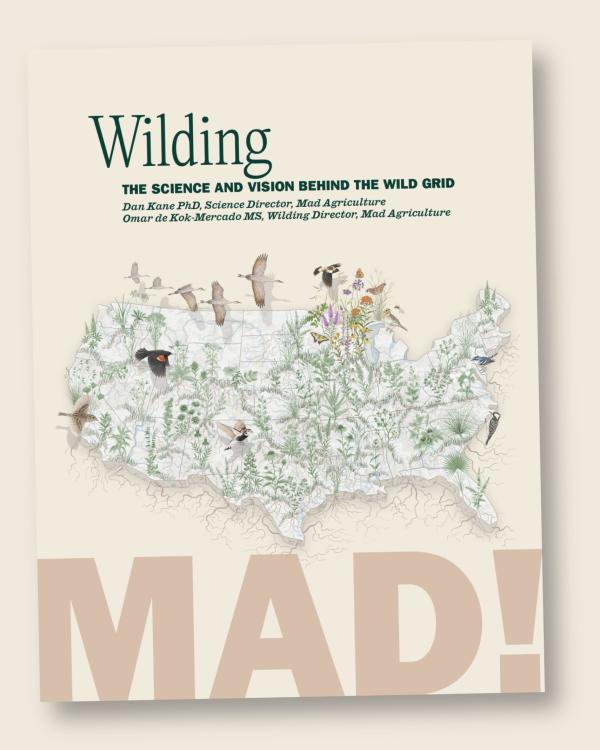
This white paper is written for farmers, food brands, conservation practitioners, investors, and policymakers who want to understand the ecological and economic case for integrating native perennial habitat into working agricultural landscapes at scale.